
If you’ve ever rented a skid steer for a “quick” job that turned into two full days of moving material, pushing snow, or cleaning up a tight site, you already know the truth:
The best skid steer rental isn’t the biggest machine — it’s the one that fits your job, your access, and your timeline.
Two Bobcat models show that tradeoff perfectly:
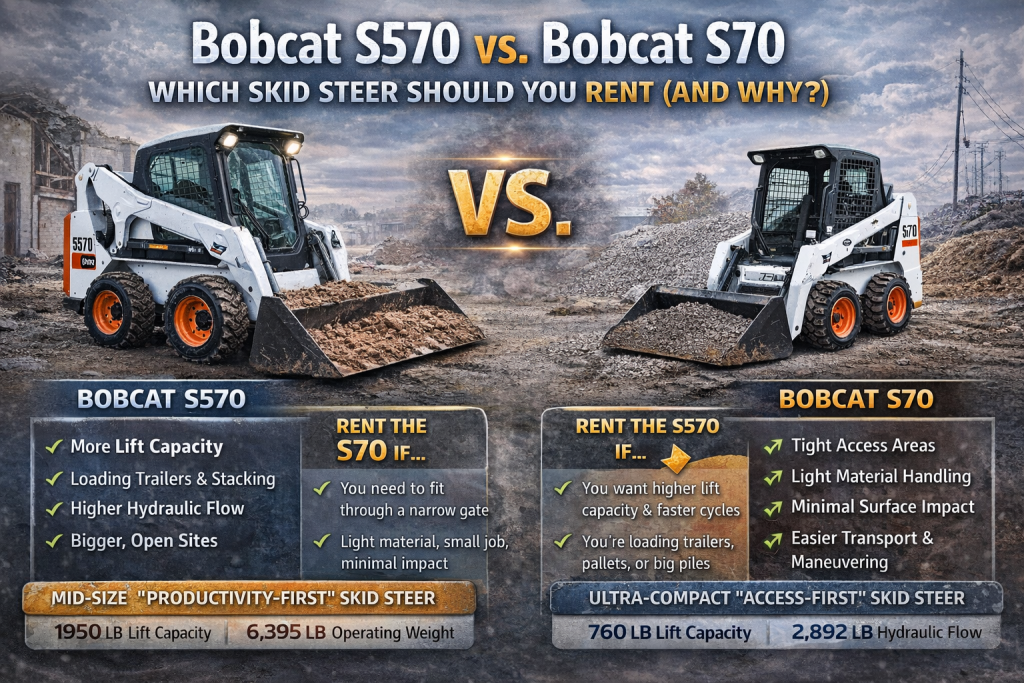
- Bobcat S570 — a mid-size, high-capacity skid steer built to move more material faster.
- Bobcat S70 — an ultra-compact skid steer (often casually called a “mini skid steer”) designed for tight access where bigger loaders can’t fit.
In this guide, we’ll compare the S570 and S70 in plain English and show exactly when it makes sense to rent one vs. the other — including winter scenarios like snow relocation, icy site cleanup, and cold-weather material handling.
Who each machine is for:
Rent the Bobcat S70 when…
- You’re working in tight spaces (narrow gates, alleys, small backyards, interior access, limited turning room)
- You need light-duty lifting and cleanup
- You’re prioritizing minimal surface disturbance (finished landscaping, pavers, delicate areas)
- You want a machine that’s easier to trailer and maneuver
Rent the Bobcat S570 when…
- You need more lift capacity and more hydraulic power
- You’re moving bigger piles (snow, gravel, debris, soil) or loading trucks regularly
- Your site has room to operate and you want maximum productivity
- You expect to run higher-demand attachments that benefit from stronger hydraulic flow
Side-by-side comparison: S570 vs. S70 (spec snapshot)
Here’s the practical difference in one glance:
Bobcat S70 (Ultra-Compact)
- Narrow footprint for confined-space work
- Lighter operating weight
- Lower lift capacity and lower hydraulic flow
- Great for “access-first” jobs
Bobcat S570 (Mid-Size)
- Much higher lift capacity
- Higher auxiliary hydraulic flow (and high-flow capability)
- Better for loading, stacking, and moving volume
- Great for “productivity-first” jobs
Important note: Specs can vary by configuration (tires, bucket, options). Your rental counter can confirm the exact unit.
The decision drivers that actually matter when renting
Most people start with horsepower or lift capacity, but the best rental decision usually comes down to these five questions:
- Can the machine physically access the work area?
- How much material (or snow) do you need to move — and how fast?
- Will you be loading trucks, stacking, or lifting pallets?
- Do you need higher hydraulic flow for an attachment?
- What’s the total cost of time on site (labor + rental days)?
Let’s break that down using real-world job scenarios.
1) Access and maneuverability: the S70 wins tight sites
If access is your biggest constraint, the S70 is the easy choice.
When the S70 is the right rental
- Backyards with narrow gates
- Side yards and alleys
- Small courtyards
- Interior or semi-interior work zones (depending on conditions and policies)
- Projects where turning room is limited
Because the S70 is so compact, it can get into areas that will shut down a larger skid steer immediately. That means less manual labor, less wheelbarrow work, and fewer “we can’t get the machine in there” surprises.
Why the S570 can struggle here
The S570 is dramatically larger. It needs:
- Wider access
- More turning room
- More staging space for safe operation
If you’re squeezing between fences, working next to finished structures, or trying to keep traffic lanes open, the S570 can feel “too much machine” for the environment — even if the job isn’t heavy.
Bottom line:If you’re renting for a residential property, tight commercial space, or any site where access is uncertain, start with the S70.
2) Lift capacity and load height: the S570 is built for real lifting
This is where the S570 earns its keep.
When lift capacity becomes the deciding factor
Rent the S570 if you’re doing things like:
- Loading dump trailers or trucks repeatedly
- Moving heavy bulk material (wet snow, gravel, base, debris)
- Handling palletized materials
- Working with attachments that add weight up front
- Stacking or placing material at height
The S70 can lift and carry — but it’s designed for lighter loads. If you try to make it do mid-size loader work, you’ll feel it in:
- Slower cycle times
- More trips
- Smaller bucket loads
- Limits on what you can safely lift and transport
A simple rule of thumb
- If your job is “move a little, in a tight space” → S70
- If your job is “move a lot, all day” → S570
3) Productivity and cycle time: the S570 usually saves a rental day
Renting bigger often costs more per day — but it can still be cheaper overall if it reduces labor and cuts the timeline.
Example: winter snow relocation after repeated storms
If you have:
- Large piles that block visibility
- Berms left by plows
- A lot that must stay open
- Snow that needs to be relocated or loaded out
…the S570 is typically the better rental. More capacity and power = fewer passes and faster loading.
Meanwhile, the S70 shines when:
- You’re clearing tight walkways or narrow service areas
- You need a machine that can move through confined zones without disruption
- You’re doing lighter cleanup that’s still too big for hand work
Winter takeaway:
- Tight access snow work → S70
- High-volume snow moving or loading → S570
4) Hydraulics and attachment performance: S570 for demanding tools
Attachments change everything. A skid steer is only as useful as the tool you’re putting on the front.
When the S570 is the better attachment platform
Choose the S570 when you plan to run:
- High-demand hydraulic attachments
- Tools that require stronger auxiliary flow
- Attachments where productivity depends on power (not just access)
Because the S570 has higher auxiliary flow (and high-flow capability), it’s much better suited for attachment-heavy days.
When the S70 is the smarter attachment choice
The S70 is excellent with:
- Small buckets
- Light material handling
- Tight-area cleanup tools
- Simple tasks where maneuverability matters more than power
If you’re choosing between the two purely based on an attachment, tell your rental team:
- What attachment you want
- What material you’re working with
- Whether you’ll be using it continuously or intermittently
They can match the machine to the attachment’s demands.
Bobcat S570 vs. S70: Choosing the Right Skid Steer Rental
If you’re handling transport yourself (or working in a location with limited staging space), logistics matter.
Why contractors love the S70 for quick jobs
- Easier to maneuver on tight sites
- Often simpler to trailer and position
- Great for short-duration tasks where setup time matters
Why the S570 is a “bring it and work all day” machine
- Better for production work
- Strong choice when you’ll be on site for a full day (or more) moving volume
- Often the right move for commercial lots, job sites, and material yards
If you’re unsure about towing requirements, trailer compatibility, or site setup, ask your rental partner about delivery options and recommended transport.
Common job scenarios: which one should you rent?
Scenario A: You’re clearing snow in tight areas
Rent the S70 if you’re working in:
- Narrow lanes
- Tight access paths
- Constrained parking zones
- Areas with limited turning space
Rent the S570 if you’re:
- Moving large piles
- Relocating snow across a lot
- Loading out snow or stacking high
Scenario B: You’re moving mulch, dirt, or gravel for a residential landscape job
Rent the S70 if access is tight and loads are lighter. Rent the S570 if you’re moving significant volume or loading dump trailers repeatedly.
Scenario C: You’re doing cleanup after a demolition or renovation
Rent the S70 for tight access and lighter debris handling. Rent the S570 if debris is heavy, you’re loading trucks, or you need production speed.
Scenario D: You’re handling pallets or heavier material placement
Rent the S570 — this is what it’s built for.The S70 can handle lighter pallets, but if pallet work is core to the day, the S570 is usually the safer and more efficient rental.
Rental decision checklist (use this before you book)
Choose the Bobcat S70 if most of these are true:
- My access is narrow or uncertain
- I’m working near finished surfaces
- I’m doing light-duty lifting and cleanup
- Maneuverability is more important than capacity
- I’d rather make more small trips than risk not fitting
Choose the Bobcat S570 if most of these are true:
- I need lift capacity and reach
- I’ll be loading trucks or moving volume all day
- The work area is open enough to operate safely
- I’m using hydraulic attachments that benefit from higher flow
- Productivity matters more than footprint
Final recommendation: rent the one that removes the bottleneck
Here’s the best way to think about it:
- If access is the bottleneck → rent the S70
- If time and volume are the bottleneck → rent the S570
And if you’re still on the fence, give us quick call with these details usually solves it fast:
- Site access width
- Material type (snow, gravel, debris, etc.)
- Whether you’re loading trucks
- Attachment needs
- Project timeline
That’s how you avoid over-renting (or under-renting) and get the most value out of every rental day.